Reuben Smith’s alcoholism
Black BeautyReuben Smith’s alcoholism turns exceptional skill into an unreliable gift: after long stretches of faithful service, he relapses, and one drunken ride ends in his death and Black Beauty’s serious injuries. The narrative presents the drinking not as a constant condition but as a recurring rupture in Smith’s work and family life. His relapse also exposes how the consequences of his conduct fall on others, including the horse he rides and the family left without a home.
Identity and Capability
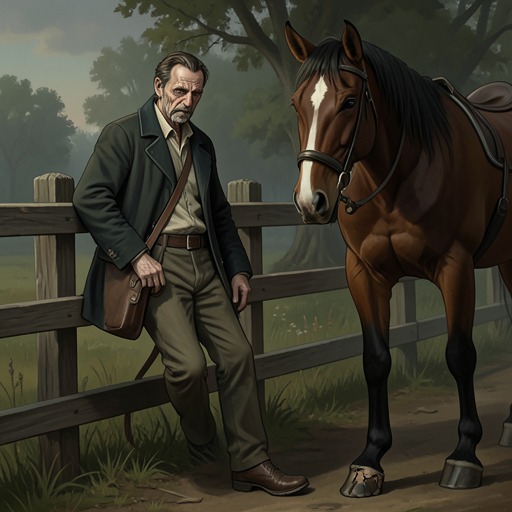
When York goes to London, Reuben Smith is left in charge of the stables. The account describes him as unusually accomplished: gentle and clever with horses, able to treat them with the knowledge he acquired during two years with a veterinary surgeon, and an excellent driver of either a four-in-hand, a tandem, or a pair. He is handsome, well educated, and agreeable in manner. The horses like him, and his practical ability makes his subordinate position under York seem surprising.
That competence matters to the portrayal of his alcoholism. Smith is not introduced as an inept or habitually intoxicated worker. When he is sober, he is considered faithful and valuable, and the narrative stresses that he can be trusted for long periods. His drinking interrupts, rather than erases, those qualities; this contrast helps explain why people around him repeatedly hope that a promise or a new opportunity will hold.
Recurring Drinking and Renewed Trust
Smith’s drinking comes in episodes. He can remain steady for weeks or months, then undergo a bout that makes him a disgrace to himself, a terror to his wife, and a source of trouble to those who depend on him. The effects are therefore not confined to the stable: Susan and their children live with the instability created by his relapses, while colleagues must manage the risk to the horses and the work.
On an earlier occasion, Smith is so drunk while driving a party home from a ball that he cannot hold the reins. One of the gentlemen has to take the box and drive the ladies. The incident cannot be concealed, and Smith is dismissed. Susan and their children are forced to leave the cottage by the park gate and find somewhere else to live. The episode establishes a pattern in which a relapse damages both his employment and the security of his family.
Smith is later taken back after York intercedes with the Earl of W——. He promises not to drink again while living there, and the narrative says he keeps that promise well enough for York to consider him safe to entrust with the stable during his absence. His return is thus built on demonstrated service as well as an explicit commitment to abstain. The fatal recurrence is more consequential because it follows this period of regained confidence: the people relying on him have reason to believe that he has become dependable again.
The Fatal Relapse
In early April, with the family expected home in May, Colonel Blantyre must return to his regiment. Smith is assigned to drive him to town in the light brougham and ride back. At the White Lion, Smith arranges for Black Beauty to be fed and ready for an early departure. A nail in the horse’s front shoe has come loose, but the hostler notices it only near the appointed time. Smith dismisses the concern and does not return for the horse until much later.
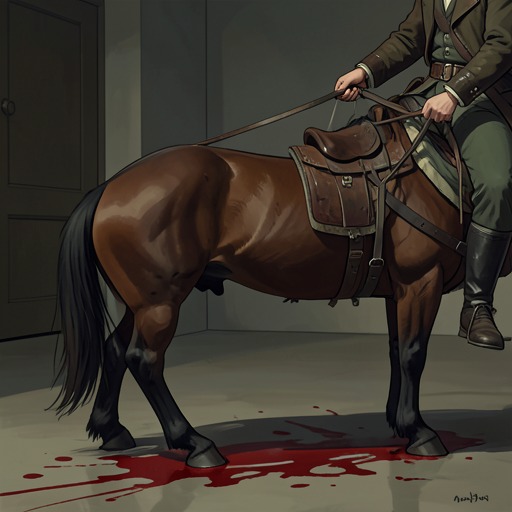
By then Smith is loud and rough in manner, and he leaves in an angry state. The narrative makes clear that he is too drunk to recognize that something is wrong with the horse’s pace. Despite Black Beauty already going at full speed, Smith gallops and uses his whip. In the darkness, on recently repaired stony roads, the loose shoe comes off. Smith continues to press the horse across a stretch of newly laid, sharp stones, without responding to the danger. The account connects the relapse to a sequence of neglect and reckless driving: the shoe is not attended to, the horse is driven hard, and Smith’s intoxication prevents him from noticing the worsening circumstances.
Black Beauty eventually stumbles and falls; Smith is thrown and does not get up. The horse is left injured beside him, unable to help either of them, and must wait for assistance. The contrast with Smith’s earlier responsible handling of horses is sharp: the man praised for particular care over loose nails now rides on after being warned about one. His drinking makes his technical ability and past promises powerless in the moment when they are most needed.
Inquest and Family Consequences
The next day, a farrier examines Black Beauty’s wounds and expects a long, painful recovery, with a lasting blemish. Smith’s death is sudden, and because no one witnessed it directly, an inquest assembles evidence from the landlord and hostler at the White Lion and other people who attest that Smith was intoxicated when he left. The toll-gate keeper reports that he rode through at a hard gallop, and Black Beauty’s lost shoe is found among the stones. Together, these details make the case clear to the inquest and Black Beauty is cleared of blame.
Smith’s death does not end the damage. Susan is nearly overwhelmed by grief and repeatedly insists on his goodness while blaming the drink. After Smith is buried, she and the six children must leave the cottage by the tall oak trees once more. With no home or relations to turn to, they go to the Union House. The earlier dismissal had already displaced them; the final relapse brings a more permanent loss, leaving them without Smith and without the home they had regained after his return to service.
Narrative Significance
Because Black Beauty narrates the episode, Smith’s drinking is measured through what it makes a horse endure and through the practical consequences visible afterward. The account does not offer Smith’s own explanation for his relapses. Instead, it sets his reputation, promises, and proven abilities against observable actions: ignoring the shoe, delaying his departure, driving while intoxicated, and failing to notice the danger. This difference between what others have trusted him to do and what he does on the fatal ride gives the recurrence its force.
The story also refuses to treat the consequences as Smith’s alone. Black Beauty is left injured and must undergo a difficult recovery; Susan and the children are displaced; and those who had tried to restore Smith’s standing lose him suddenly. The inquest assigns no blame to the horse, but its evidence traces the fatal ride back to Smith’s intoxication and decisions. His alcoholism is thus shown as a recurring personal crisis with consequences carried by people and animals who depend on him.